Action tokenizers define the action representations learned by autoregressive vision-language-action models. Reconstruction accuracy measures the fidelity of individual actions, while their physical relationships provide structure for learning across demonstrations. We introduce physical rank consistency (PRC) to measure neighborhood-order preservation through encoding and decoding, providing a common evaluation across token vocabularies and decoder architectures. Guided by this perspective, we develop ActionPiece, which jointly augments reconstruction with physical rank preservation in learned representations and quantization regularization over codeword assignments. Under the same Qwen3-VL-4B policy training setup, ActionPiece achieves 94.8% on LIBERO and 68.8% on unseen LIBERO-Plus. Component ablations improve both PRC and policy success, with the two objectives together performing best. Replacing the action tokenizer also achieves 71.9% on SimplerEnv and 51.5% mean success across VLA-Arena L0–L2 with standard next-token prediction. These results support physical relationship supervision as a useful principle for learning action representations for control.
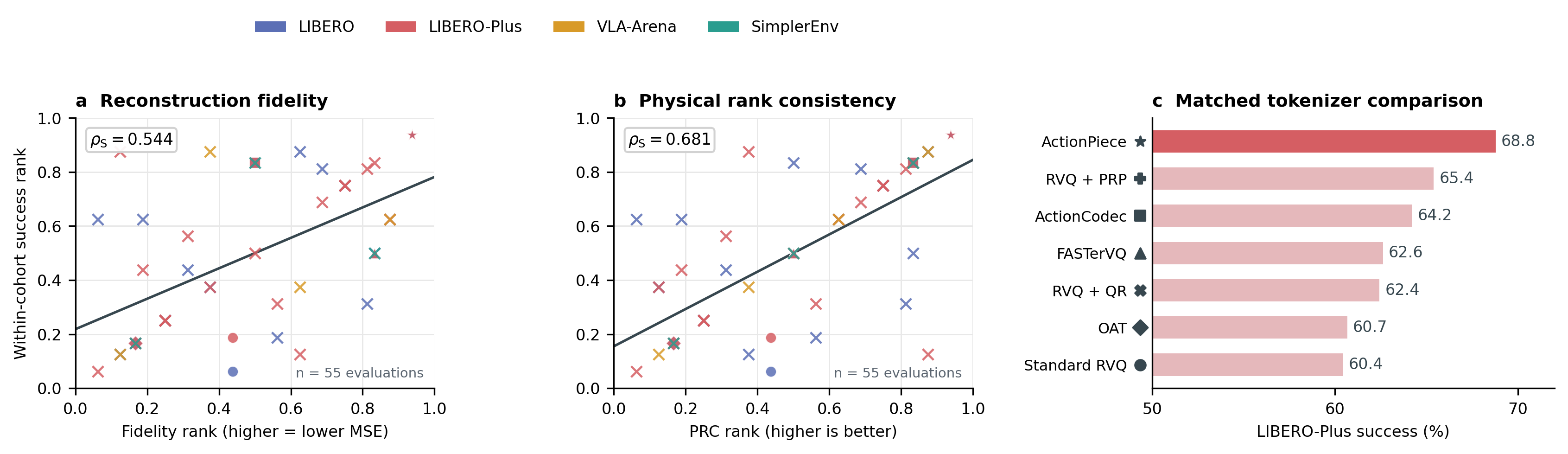
Physical rank consistency (PRC) measures how well tokenization preserves the neighborhood ordering of actions. Figure 1 compares reconstruction fidelity and PRC with policy success across 55 tokenizer–benchmark evaluations. Ranks are normalized within comparison groups; color denotes the benchmark. These descriptive associations motivate preserving physical relationships alongside accurate reconstruction. The right panel shows the matched LIBERO-Plus comparison.
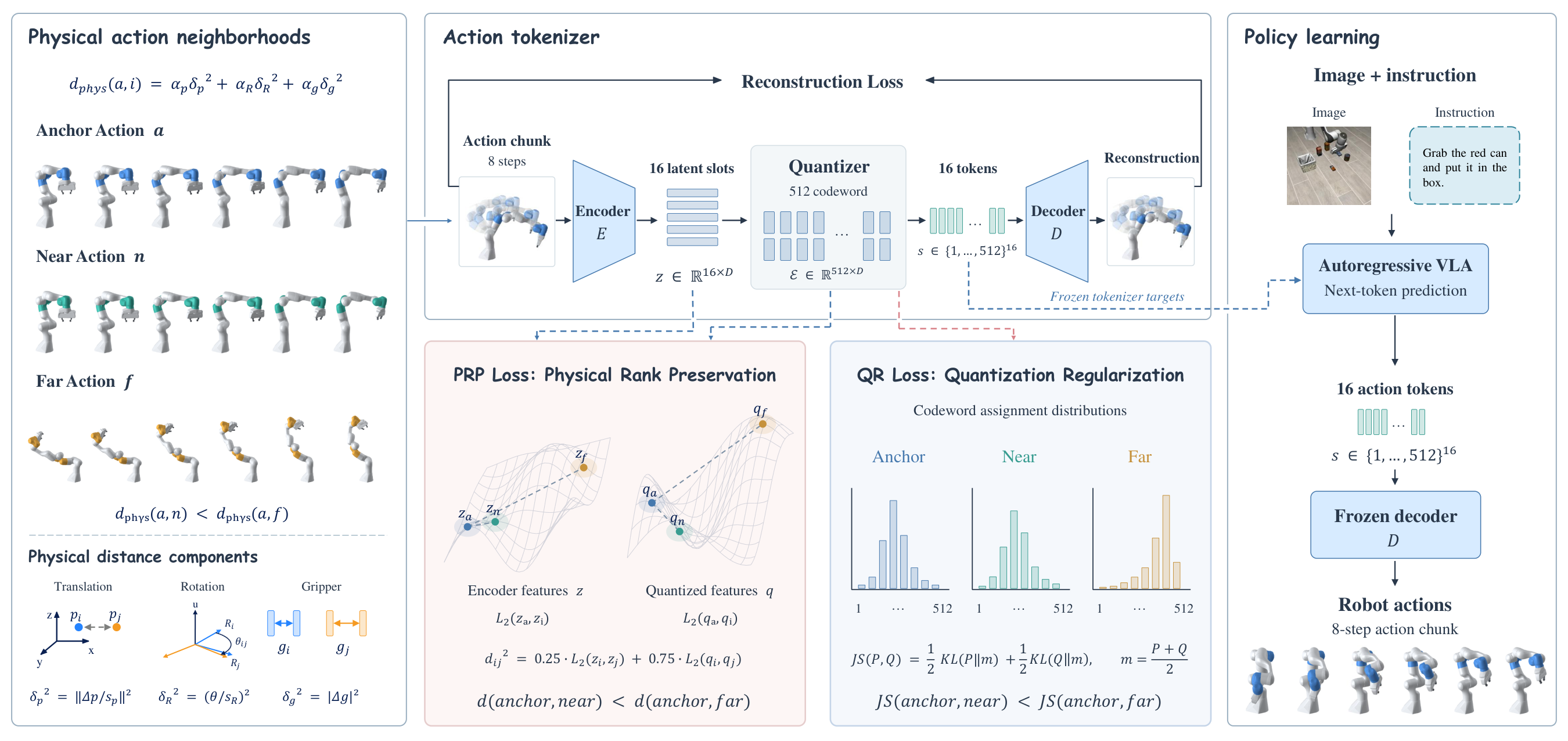
ActionPiece Architecture
Physical relationship supervision for action tokenization and autoregressive policy learning.
Physical action distance combines translation, rotation, and gripper differences to select near and far action chunks. The tokenizer maps each eight-step chunk to 16 discrete tokens. Alongside reconstruction, physical rank preservation (PRP) encourages near–far ordering in encoder and quantized feature distances, while quantization regularization (QR) encourages the same ordering in the Jensen–Shannon divergence between codeword assignment distributions. The frozen tokenizer provides targets for autoregressive VLA training, and its decoder converts predicted tokens into executable action chunks.
View full-resolution PDF.
LIBERO
& LIBERO-Plus
In-distribution task performance and generalization to seven types of perturbations.
LIBERO
Overall success ↑
ActionPiece (Ours)
94.8
%
ActionCodec
93.7
%
FAST
92.1
%
FASTerVQ*
91.3
%
Standard RVQ
90.9
%
OAT
86.1
%
LIBERO-Plus
Overall success ↑
ActionPiece (Ours)
68.8
%
FAST
64.3
%
ActionCodec
64.2
%
FASTerVQ*
62.6
%
OAT
60.7
%
Standard RVQ
60.4
%
LIBERO · success rate (%)
Tokenizer
Spatial
Object
Goal
Long
Overall
ActionCodec
93.4
99.0
92.4
89.8
93.7
OAT
85.6
96.2
87.2
75.2
86.1
FASTerVQ*
91.8
95.6
90.5
87.4
91.3
FAST
94.7
98.0
93.1
82.6
92.1
Standard RVQ
91.8
98.2
91.6
82.0
90.9
ActionPiece (Ours)
96.2
99.0
93.4
90.6
94.8
LIBERO-Plus · success rate (%)
Tokenizer
Camera
Robot
Language
Light
Background
Noise
Layout
Overall
ActionCodec
33.3
38.8
80.8
88.4
90.2
58.0
75.9
64.2
OAT
32.2
47.8
79.5
82.8
82.7
46.4
67.4
60.7
FASTerVQ*
39.0
42.3
74.5
85.8
84.9
56.6
69.0
62.6
FAST
33.8
47.1
80.0
89.6
88.4
51.3
75.9
64.3
Standard RVQ
31.5
43.9
75.3
86.0
88.0
42.5
72.9
60.4
ActionPiece (Ours)
45.1
49.6
82.2
91.9
91.4
57.6
78.0
68.8
All policies use the same Qwen3-VL-4B backbone and matched policy-training setup. LIBERO-Plus demonstrations are excluded from policy training. FASTerVQ* denotes our implementation following the published method. Values follow the paper tables and are displayed to one decimal place.
SimplerEnv
Real-to-sim evaluation of a WidowX policy trained on real-world demonstrations.
71.9
%
ActionPiece · average success
Four manipulation tasks:
Put Spoon, Put Carrot, Stack Block, Put Eggplant.
Model
Put Spoon
Put Carrot
Stack Block
Put Eggplant
Avg.
RT-1-X
0.0
4.2
0.0
0.0
1.1
Octo-Base
0.0
12.5
15.8
41.7
17.5
Octo-Small
0.0
8.2
41.7
56.7
26.7
OpenVLA-OFT
34.2
30.0
30.0
72.5
41.8
RoboVLM
50.0
37.5
0.0
83.3
42.7
Magma
37.5
29.2
20.8
91.7
44.8
CogACT
71.7
50.8
15.0
67.5
51.3
SpatialVLA
20.8
20.8
25.0
70.8
34.4
TraceVLA
12.5
16.6
16.6
65.0
27.7
VideoVLA
75.0
20.8
45.8
70.8
53.1
π₀
29.2
62.5
29.2
91.6
53.1
π₀.₅
49.3
64.7
44.7
69.7
57.1
Isaac-GR00T-N1.6-Bridge
64.5
65.5
5.5
93.0
57.1
LangForce
89.6
63.8
33.3
79.2
66.5
ActionCodec-BAR
71.7
64.2
55.0
70.0
65.2
ActionPiece (Ours)
83.3
54.2
58.3
91.7
71.9
We follow the official SimplerEnv evaluation protocol, averaging five independent 24-episode repeats per task and then the four task scores. ActionPiece achieves the best average among the listed methods, with strengths varying across tasks. It uses standard next-token prediction with the action tokenizer replaced, without benchmark-specific changes to the policy architecture.
VLA-Arena
Train on L0 and evaluate across L0–L2: safety, distractors, extrapolation and long-horizon tasks.
Across all levels
Mean success ↑
ActionPiece
51.5
%
LingBot-VLA
51.0
%
π₀.₅
41.5
%
Evo-Depth
41.1
%
Motus
38.9
%
Qwen-GR00T
37.6
%
GR00T-N1.6
27.8
%
π₀-FAST
23.0
%
By difficulty
Success rate (%) ↑
Model
L0
L1
L2
π₀.₅
64.3
35.6
24.5
GR00T-N1.6
50.3
23.6
9.5
Qwen-GR00T
76.9
23.5
12.5
Evo-Depth
75.0
31.6
16.7
Motus
60.1
35.7
20.9
ActionPiece
82.2
42.7
29.5
Task success (%) · L0 / L1 / L2
Task
π₀.₅
GR00T-N1.6
Qwen-GR00T
Evo-Depth
Motus
ActionPiece
Static obstacles
90.0 / 62.0 / 40.0
72.0 / 30.0 / 14.0
91.0 / 18.0 / 5.0
88.0 / 66.0 / 48.0
64.0 / 67.0 / 41.0
91.0 / 83.0 / 57.0
Cautious grasp
50.0 / 14.0 / 0.0
16.0 / 2.0 / 0.0
77.0 / 8.0 / 2.0
78.0 / 24.0 / 0.0
62.0 / 25.0 / 11.0
77.0 / 18.0 / 1.0
Hazard avoidance
58.0 / 30.0 / 36.0
64.0 / 4.0 / 10.0
67.0 / 15.0 / 19.0
40.0 / 0.0 / 14.0
65.0 / 34.0 / 21.0
68.0 / 22.0 / 46.0
State preservation
58.0 / 56.0 / 54.0
66.0 / 50.0 / 38.0
86.0 / 56.0 / 47.0
88.0 / 66.0 / 56.0
63.0 / 63.0 / 72.0
94.0 / 80.0 / 64.0
Dynamic obstacles
50.0 / 44.0 / 22.0
74.0 / 50.0 / 2.0
81.0 / 56.0 / 3.0
82.0 / 60.0 / 6.0
58.0 / 33.0 / 11.0
82.0 / 76.0 / 27.0
Static distractors
88.0 / 16.0 / 16.0
46.0 / 32.0 / 6.0
91.0 / 6.0 / 2.0
94.0 / 20.0 / 24.0
69.0 / 19.0 / 13.0
92.0 / 21.0 / 22.0
Dynamic distractors
80.0 / 66.0 / 54.0
70.0 / 72.0 / 18.0
92.0 / 49.0 / 25.0
86.0 / 60.0 / 32.0
77.0 / 51.0 / 26.0
90.0 / 63.0 / 43.0
Prep. combinations
62.0 / 24.0 / 6.0
48.0 / 0.0 / 0.0
51.0 / 1.0 / 0.0
66.0 / 0.0 / 0.0
41.0 / 7.0 / 1.0
69.0 / 15.0 / 0.0
Task workflows
38.0 / 20.0 / 22.0
42.0 / 0.0 / 0.0
51.0 / 3.0 / 9.0
32.0 / 0.0 / 0.0
38.0 / 25.0 / 14.0
64.0 / 33.0 / 21.0
Unseen objects
48.0 / 60.0 / 20.0
26.0 / 18.0 / 16.0
63.0 / 46.0 / 26.0
78.0 / 52.0 / 4.0
63.0 / 65.0 / 19.0
78.0 / 59.0 / 43.0
Long horizon
85.0 / 0.0 / 0.0
29.0 / 2.0 / 0.0
96.0 / 0.0 / 0.0
93.0 / 0.0 / 0.0
61.0 / 4.0 / 1.0
99.0 / 0.0 / 0.0
Avg
64.3 / 35.6 / 24.5
50.3 / 23.6 / 9.5
76.9 / 23.5 / 12.5
75.0 / 31.6 / 16.7
60.1 / 35.7 / 20.9
82.2 / 42.7 / 29.5
Avg equally weights the 11 task suites at each level; the overall mean equally weights all 33 suite–level results. ActionPiece achieves the best aggregate success among the listed methods, while individual task strengths vary. The policy uses standard next-token prediction with ActionPiece as its tokenizer, without benchmark-specific architectural changes. Qwen-GR00T denotes Qwen3-VL with the GR00T N1 action head.
Citation
If you find ActionPiece useful in your research, please cite our paper.
@misc{lian2026actionpiece,
  title={ActionPiece: Rethinking Action Tokenization for Autoregressive Vision-Language-Action Models},
  author={Shijie Lian and Bin Yu and Zhaolong Shen and Xiaopeng Lin and Yichao Du and Zhirui Zhang and Laurence T. Yang and Kai Chen},
  year={2026},
  eprint={2609.18487},
  archivePrefix={arXiv},
  primaryClass={cs.RO},
  url={https://arxiv.org/abs/2609.18487}
}