Technical Report · 2026

PhysBrain 1.5

From General VLMs to Physical Foundation Model

A unified embodied vision-language model that understands the observed world, generates goal-directed actions, and predicts how the environment will evolve — all as discrete tokens under a single shared autoregressive backbone.

72.5
Overall score · open-source SOTA
28
Embodied benchmarks evaluated
#1
On 14 benchmarks among open-source
8B
Parameters · Qwen3-VL backbone
One Model · Three Capabilities

A Foundation Model for the Physical World

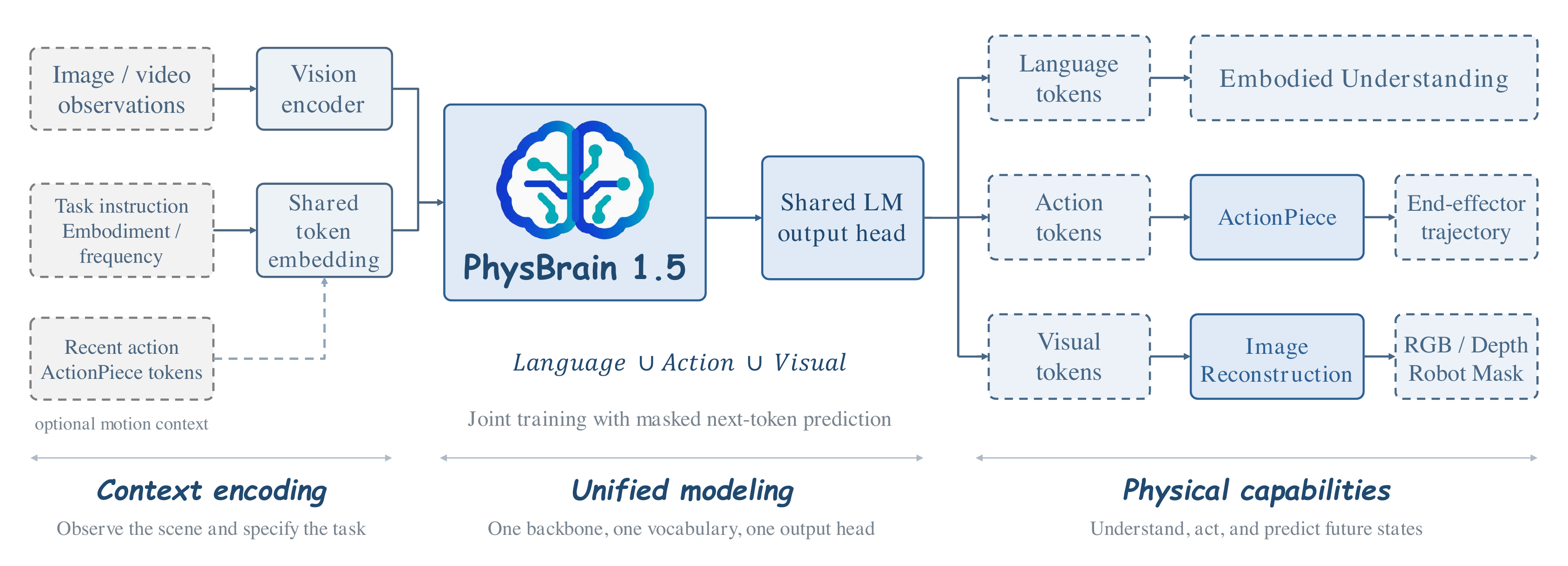
PhysBrain 1.5 mirrors the closed physical loop of agent–environment interaction: observations guide reasoning and action, actions alter the environment, and the updated state feeds back as the next observation. Language responses, structured spatial outputs, end-effector trajectories, and future world states are all formulated as discrete tokens and jointly learned under a unified next-token prediction objective — no task-specific heads.

👁️

Embodied Understanding

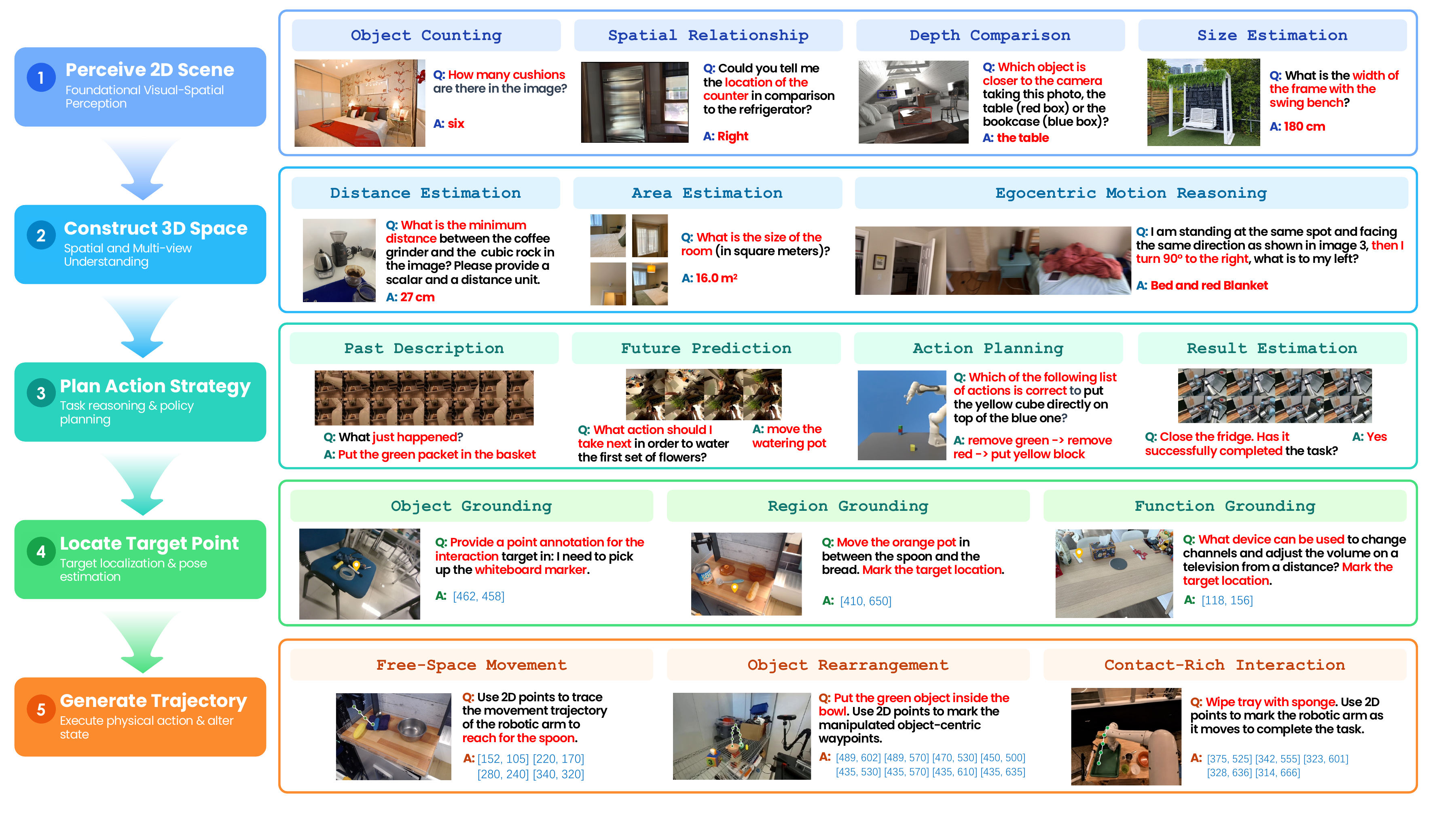
Visual-spatial perception, 3D & multi-view reasoning, embodied planning, pointing & affordance grounding, and visual-trace reasoning across 28 benchmarks.

🦾

Action Generation

ActionPiece tokens encode end-effector trajectories in a unified action codebook shared across control configurations and arm setups — one generalist checkpoint drives varied robotic platforms.

🔮

Future-State Prediction

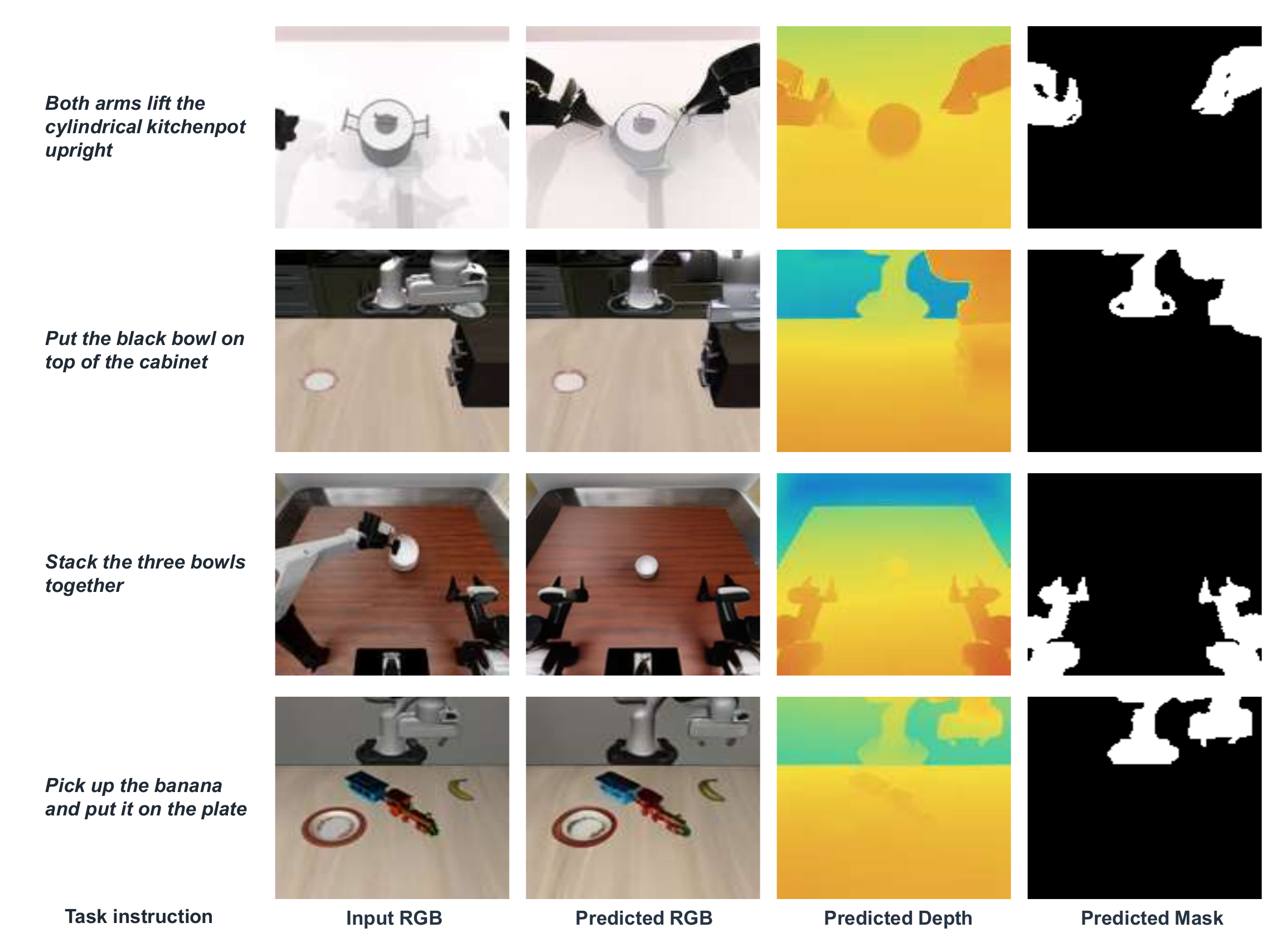
Predicts the world one step ahead as spatially aligned RGB images, depth maps, and robot masks — a multimodal world model inside the same vocabulary.

The Physical Loop

Observe → Reason → Act → World Changes

Observations guide reasoning and action; actions change the world, and updated observations feed back into the next round. PhysBrain 1.5 learns understanding, action generation, and future-state prediction within one shared autoregressive model.

01

Observe

Perceive 2D scenes and construct 3D spatial representations.

02

Reason & Ground

Plan strategies, localize targets, and ground affordances.

03

Act

Generate goal-directed end-effector trajectories.

04

World Changes

Predict state transitions; new observations close the loop.

Learning from interaction. Pre-training draws its embodied supervision entirely from human interaction videos — egocentric, synchronized ego–exocentric, and panoramic recordings structured into task-centered episodes. Supervised fine-tuning then combines human demonstrations, real-robot trajectories, and simulated experience.

Architecture

Unified Tokens, Shared Backbone

Built on pretrained Qwen3-VL and extended with dedicated action and visual-state tokens. Semantic, motion, and future-state supervision all update the same parameters through one next-token prediction objective.

PhysBrain 1.5 model architecture

PhysBrain 1.5 model architecture — language, action, and visual tokens in a single autoregressive stream.

Evaluation

Open-Source State of the Art

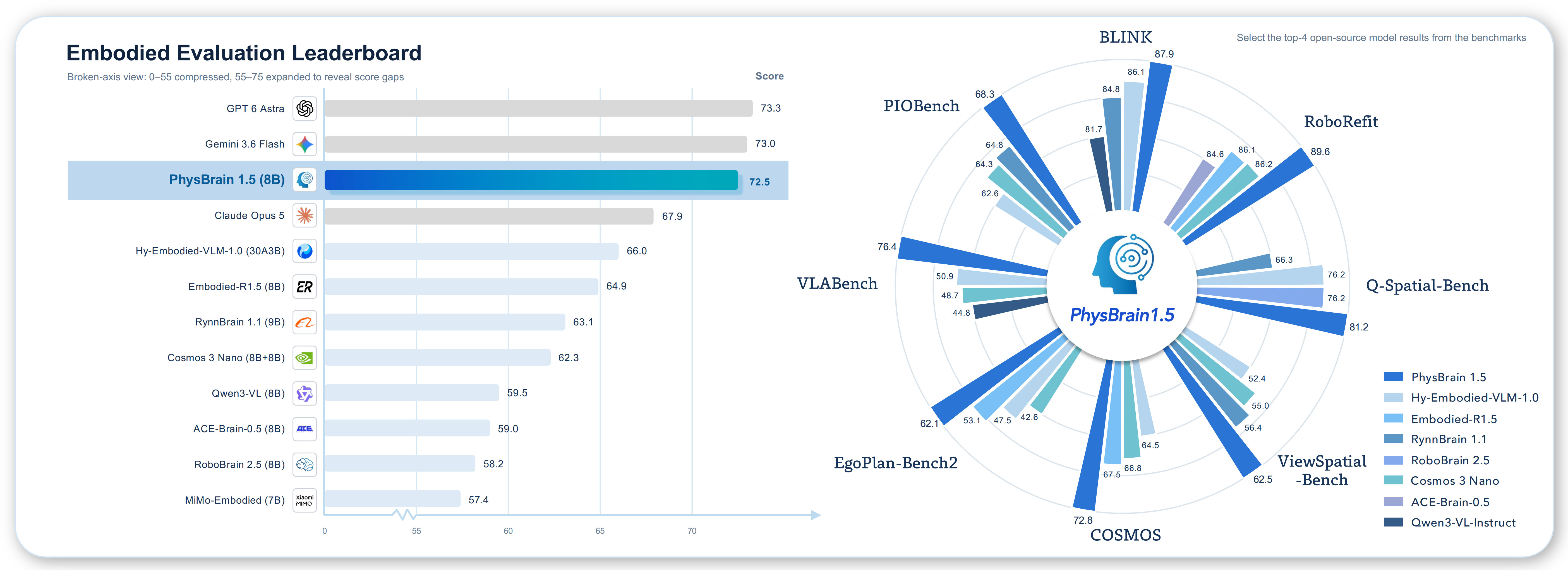
Across 28 embodied spatial-intelligence and planning benchmarks, PhysBrain 1.5-8B achieves an overall score of 72.5 — ranking first among open-source models and performing on par with leading proprietary systems such as GPT-6-Astra (73.3) and Gemini 3.6 Flash (73.0). It ranks first on 14 benchmarks and second on 10 among open-source models.

🏆 72.5 overall — #1 open-source 14× first place 10× second place Comparable to proprietary frontier
Leaderboard
PhysBrain 1.5 leaderboard across embodied benchmarks

Overall embodied-benchmark scores. All models are independently re-evaluated with one canonical metric per benchmark for direct comparability.

Detailed benchmark results

28 benchmarks · 13 models · Scores out of 100, higher is better. Scroll to compare all models.

Best open-source Second-best open-source Muted text: reference only
Results on embodied understanding across 28 benchmarks. Closed-source models and PhysBrain 1.5-2B are excluded from ranking.
Benchmark Closed source Open source
Gemini 3.6 Flash GPT 6 Astra Claude Opus 5 Hy-Emb.-VLM-1.0 Embodied-R1.5 RynnBrain1.1 RoboBrain2.5 MiMo Embodied Cosmos3 Nano ACE-Brain-0.5 Qwen3-VL-Inst. PhysBrain 1.5 PhysBrain 1.5
30A3B 8B 9B 8B 7B 8B+8B 8B 8B 2B 8B
01 · Foundational Visual-Spatial Perception
BLINK 89.2 80.6 85.5 86.1 78.6 84.8 80.4 69.5 80.6 77.8 81.7 81.9 87.9
CV-Bench 90.0 84.9 87.8 89.3 86.9 88.1 88.0 89.4 88.3 85.0 85.8 87.6 90.0
02 · Spatial and Multi-view Understanding
3DSRBench 67.7 62.3 63.3 62.1 52.3 59.0 54.7 53.2 53.5 51.8 53.6 59.3 63.0
EmbSpatial-Bench 84.7 79.8 81.1 80.5 75.2 81.9 77.9 77.0 82.1 77.9 79.9 78.9 81.8
MindCube 77.1 78.8 66.7 65.4 30.9 82.1 30.4 31.3 39.2 94.2 33.9 60.9 86.2
MMSI-Bench 52.8 57.9 44.1 39.0 30.1 46.0 29.4 31.8 35.7 35.8 30.8 30.7 41.0
Q-Spatial-Bench 87.1 68.3 74.3 76.2 51.5 66.3 76.2 47.5 46.5 35.6 54.5 69.3 81.2
RoboSpatial-Home 71.0 73.7 72.0 71.2 72.0 70.4 67.3 60.1 66.4 65.9 67.7 65.0 73.9
SAT 88.7 96.7 88.7 81.3 74.0 78.0 65.3 76.0 69.3 79.3 70.7 73.3 79.3
VSI-Bench 51.8 59.8 21.3 55.7 56.3 65.9 43.9 45.0 50.4 57.9 55.1 57.3 61.9
ViewSpatial-Bench 56.6 54.2 49.8 52.4 43.9 56.4 39.3 39.7 55.0 48.3 40.3 58.1 62.5
03 · Embodied Cognition, Reasoning, and Planning
COSMOS 65.3 75.7 71.0 64.5 67.5 64.3 57.7 56.5 66.8 46.5 60.6 71.2 72.8
EgoPlan-Bench2 53.1 69.3 48.4 47.5 53.1 37.0 33.8 37.9 42.6 33.5 32.1 56.1 62.1
ERQA 72.3 75.8 61.5 56.3 42.3 46.5 44.3 44.8 47.5 45.3 42.5 44.0 52.8
ERQA-PLUS 92.2 86.1 88.3 82.2 80.7 83.6 81.1 81.1 83.5 81.4 82.5 79.2 85.2
RoboVQA 41.7 37.0 36.0 41.2 60.8 60.9 48.4 55.5 51.5 44.7 58.5 62.9 61.5
VLABench 64.7 66.3 60.3 50.9 40.9 42.4 37.6 39.9 48.7 29.1 44.8 73.4 76.4
04 · Spatial Grounding, Pointing, and Affordance
Part-Affordance 64.7 55.0 78.1 62.8 83.4 40.5 24.7 61.9 33.3 36.3 56.4 83.7 84.0
PIOBench 80.9 79.7 71.6 62.6 61.5 64.8 62.3 56.2 64.3 60.4 53.7 54.4 68.3
PixMo-Points 74.8 75.2 56.7 55.8 65.3 29.9 57.3 51.5 60.5 65.6 53.7 52.3 62.2
PointBench 69.6 71.9 68.6 61.1 64.5 45.5 61.7 51.6 62.8 63.0 61.5 59.2 64.3
RefSpatial-Bench 76.4 78.0 56.3 47.4 55.2 63.2 59.9 40.0 52.8 53.3 43.6 37.6 50.9
RoboAfford 83.4 84.6 82.3 75.8 76.9 74.0 71.7 71.8 81.1 71.8 66.8 75.9 80.4
RoboRefit 85.9 85.1 83.5 82.5 86.1 81.9 82.8 75.5 86.2 84.6 81.3 86.8 89.6
VABench-Point 60.7 65.3 64.7 60.5 75.7 15.8 10.6 47.7 53.2 5.3 46.3 60.3 65.2
Where2Place 73.4 76.9 69.0 65.4 75.0 72.7 72.0 63.9 74.4 56.0 64.7 70.7 72.1
05 · Visual Trace and Trajectory Reasoning
ShareRobot-Traj. 82.8 83.1 81.9 84.5 84.0 79.3 85.2 69.0 80.9 82.1 78.2 85.0 84.9
VABench-V.-Trace 84.2 91.6 88.9 87.5 92.3 86.6 85.4 82.1 88.3 82.7 84.4 88.9 89.8
Overall Average 73.0 73.3 67.9 66.0 64.9 63.1 58.2 57.4 62.3 59.0 59.5 66.6 72.5

Closed-source models and PhysBrain 1.5-2B are shown for reference and excluded from ranking. Best and second-best results include ties. Overall Average is the unweighted mean across the 28 benchmarks at the reported precision.

C1

Foundational Visual-Spatial Perception

Object counting, spatial relationships, relative depth, metric size estimation.

C2

3D & Multi-View Understanding

Metric distance estimation, room area, egocentric motion under viewpoint shifts.

C3

Embodied Cognition & Planning

Past-action description, counterfactual prediction, goal decomposition, outcome estimation.

C4

Grounding, Pointing & Affordance

Point-level grounding, target localization, functional affordance identification.

C5

Visual Trace & Trajectory Reasoning

Obstacle-free waypoints, object rearrangement, contact-rich manipulation traces.

C6

Action & Future Prediction

End-effector trajectory chunks and RGB + depth + robot-mask future states.

Qualitative evaluation cases of embodied spatial intelligence and planning

Qualitative examples of embodied spatial intelligence and planning.
Action Prediction

One Checkpoint,
Many Robots

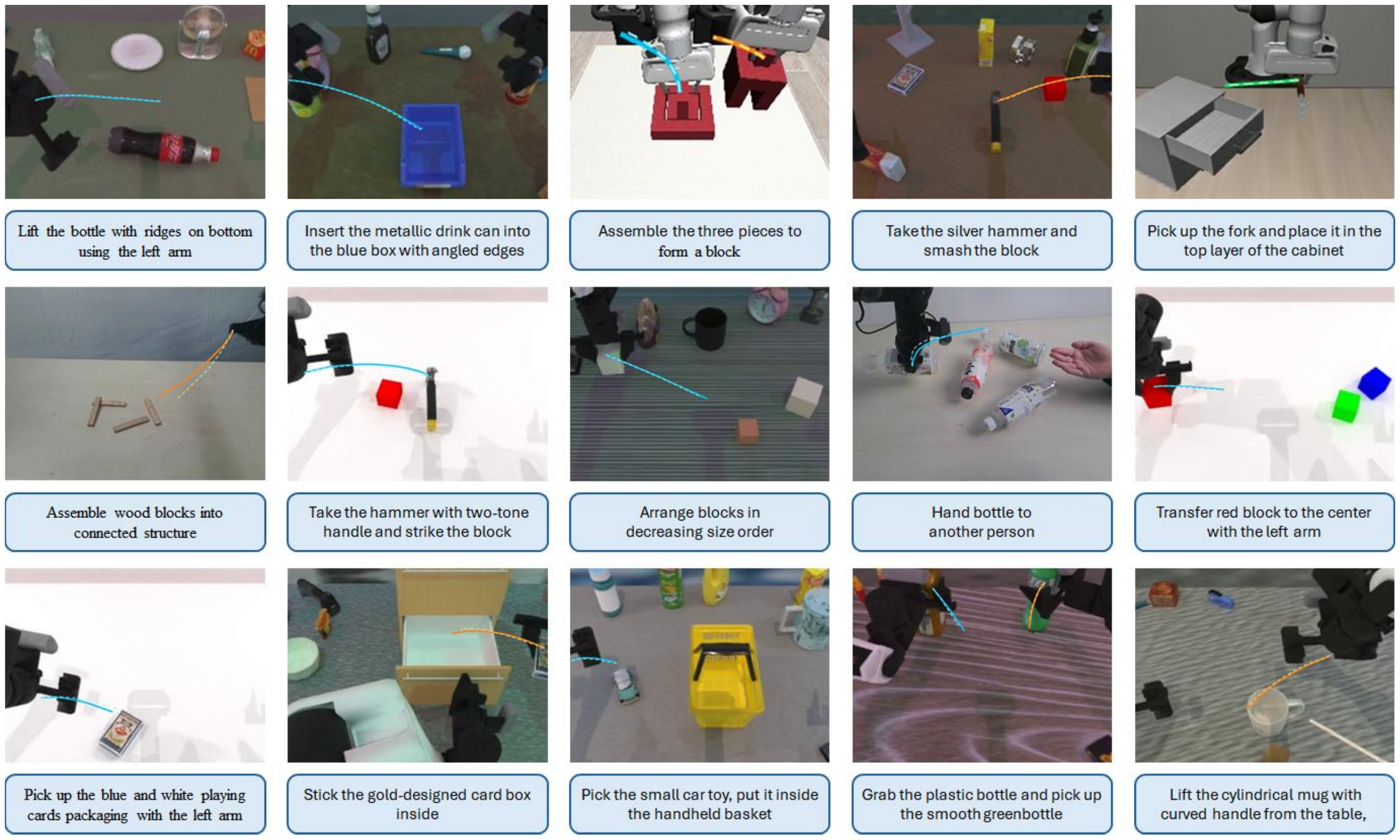
Given a task instruction, current observations, and optional recent action history, PhysBrain 1.5 predicts the next end-effector action chunk as a compact sequence of ActionPiece tokens. A unified action codebook and vocabulary are shared across diverse control configurations and arm setups, enabling a single generalist checkpoint to drive varied robotic platforms and manipulation settings.

Qualitative results of action trajectory prediction

Qualitative results of action trajectory prediction.

Future visual prediction across diverse robot embodiments

Future visual prediction across diverse robot embodiments.

Future-State Prediction

Anticipating How
the World Changes

Given the current observation and a task instruction, PhysBrain 1.5 anticipates how actions may reshape the environment. It represents a possible future world state through spatially aligned RGB imagery, depth maps, and robot masks across diverse robot embodiments.

Quick Start

Standard Interface, Instant Integration

PhysBrain 1.5 uses pretrained Qwen3-VL as its backbone with an extended vocabulary. Its standard model interface lets you reuse existing infrastructure for inference and post-training.

TransformersvLLMSGLangLLaMA-Factoryms-swiftveRL
Citation

Cite PhysBrain 1.5

If you use PhysBrain 1.5 in your research, please cite our technical report.

citation.bib
@misc{physbrain1.5,
  title  = {PhysBrain 1.5 Technical Report},
  author = {{DeepCybo Team}},
  year   = {2026},
  url    = {https://github.com/DeepCybo-PhysAI/PhysBrain-1.5}
}